Expansive Canyonlands
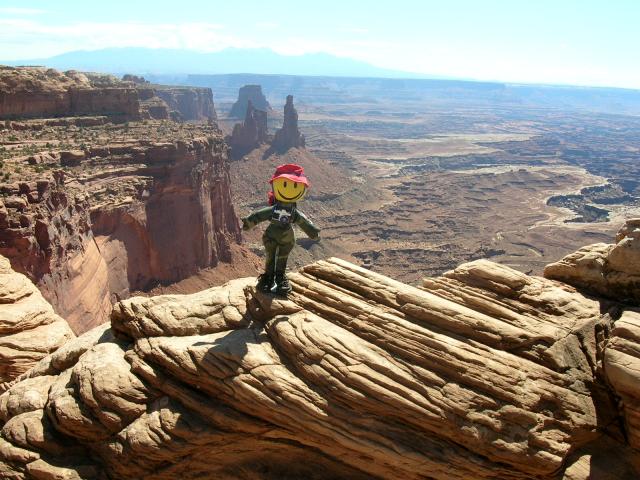

The canyons and landscapes of Canyonlands National Park are expansive
to begin with. In addition, the layout of the park is unusual in that
it is geographically divided into four districts by the winding Colorado
and Green Rivers. Driving to any of the park’s districts will take at
least an hour – making it too rushed to try to fit in more than one
section in a day. We think it’s also a good idea to plan ahead by
picking up some information about Canyonlands at the Arches National
Park Visitor Center, or at the Information Center in Moab, Utah.
Here is a summary of the Canyonlands National Park districts:
The Island in the Sky is the most accessible:
Stop at the Visitor
Center for the film, information and schedule of ranger talks. The scenic drive has a
number of overlooks. Grandview Point is a must-see overlook, and you
can take a very worthwhile 2-mile roundtrip hike along the rim to a
lookout-point with fantastic views.
Be sure to stop at Mesa Arch and
walk the short trail to see the arch and the view. There are a number
of other lookout points along the scenic drive – all are worth taking a
look. Upheaval Dome is the site of a large crater with undetermined
origins. Walk up the short trail to take a peek, but we don’t think the
longer hike to the further overlook is worth the effort. There are
picnic areas at White Rim and Upheaval Dome overlooks.
For longer hikes, check with the ranger at the Visitors
Center. We were told about a 10-mile hike starting at Murphy Point down
to the White Rim and back up. We ran out of time to spend in the area,
so we will have to do this hike the next time around in Canyonlands.
If you want a break from your RV, you can take to more primitive
camping experiences. The 100-mile White Rim Road, per the Park Service
material we received, takes two to three days by four-wheel-drive
vehicle, or longer by mountain bike. There are campsites along this
road for primitive camping.
The Needles section:


This area is described as being more of a backcountry experience. It is in the
southeast corner of Canyonlands. There are interconnecting trails for
long day hikes and overnight trips, and many 4-wheel drive roads.
For
the more casual visitor, there is a scenic drive with a number of
overlooks that afford views of the sandstone spires in this region. We
took a hike from the Elephant Hill trailhead to Chesler Park.
We had planned to just hike a mile in to get a view of the sandstone
spires, but we ended up hiking all the way to Chesler Park and back,
making it about 6-miles round-trip.
On the road leading to the Needles, make a quick stop at
Newspaper Rock, a small wall with a myriad of petroglyphs from various
peoples through the ages.
On the way back to Moab from the Needles, we made a quick stop at
the Hole-in-the-Rock on Route 191, a humorous roadside stop. Here you
can take a tour of a unique 5,000 square foot home built into the cliff
or just take a look at the Trading Post, petting zoo and assorted relics
of art and what-not that are scattered about the property.
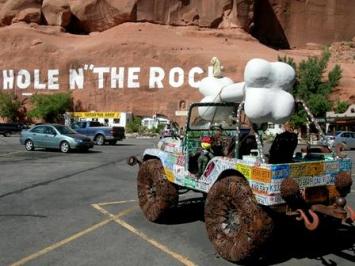

On the way back to Moab from the Needles, we made a quick stop at
the Hole-in-the-Rock on Route 191, a humorous roadside stop.
Here you
can take a tour of a unique 5,000 square foot home built into the cliff
or just take a look at the Trading Post, petting zoo and assorted relics
of art and what-not that are scattered about the property.
The Maze is even more remote:
This area has difficult roads and trails. While
Island in the Sky and he Needles sections are accessible from the Moab
area, the Maze is reached from Utah Highway 24, south of I-70. Near
the turnoff to Goblin State Park, there is a 46-mile dirt road to the
Hans-Flat Ranger Station. The four-wheel drive and back country trails
of the Maze spread out from beyond this station.
Due to the remote and
difficult navigation in this area, most backcountry visitors spend days
in the Maze, once they get here. The Horseshoe Canyon Unit was added to
Canyonlands in 1971, known for the significant rock art panel, the
Great Gallery. We put the Great Gallery on our list of things to see
the next time we are through this part of Utah.
The Rivers is the fourth district of
Canyonlands:
 |
Within the park, the Colorado and Green Rivers converge at
what is known as the Confluence. Flat-water trips can be made above the
Confluence, whitewater rapids are below this point. Permits are
required and river trips must be self-sufficient as there are no
facilities.
Much of Canyonlands is known for its primitive nature and as a
destination for back country travel. Activities requiring a permit
include backpacking, four-wheel-drive and mountain bike camping, and
river-trips.
Even if you are not interested in a backcountry
experience, a visit to
Canyonlands
offers expansive vistas and scenery. Another grand stop in the Grand Circle of National Parks in Utah.

Jill Miller is the founder of Your RV Lifestyle. Trading corporate America for the open road, Jill, along with her partner Jose, began their RV journey, making an unconventional start by wintering in New Jersey. A natural adventurer, she was motivated by a desire to explore the USA and beyond, embracing the varied landscapes, communities, and cultures across the country.
For Jill, the allure of RV living was not about material accumulation, but rather the pursuit of an adventurous, fulfilling lifestyle. A lover of golf, bicycling, hiking, and line dancing, she has carried her passions across the country, engaging with them in diverse settings. Jill’s commitment to the RV lifestyle came after years of careful research, numerous consultations with RV owners, and personal trials, including living in a rental RV.